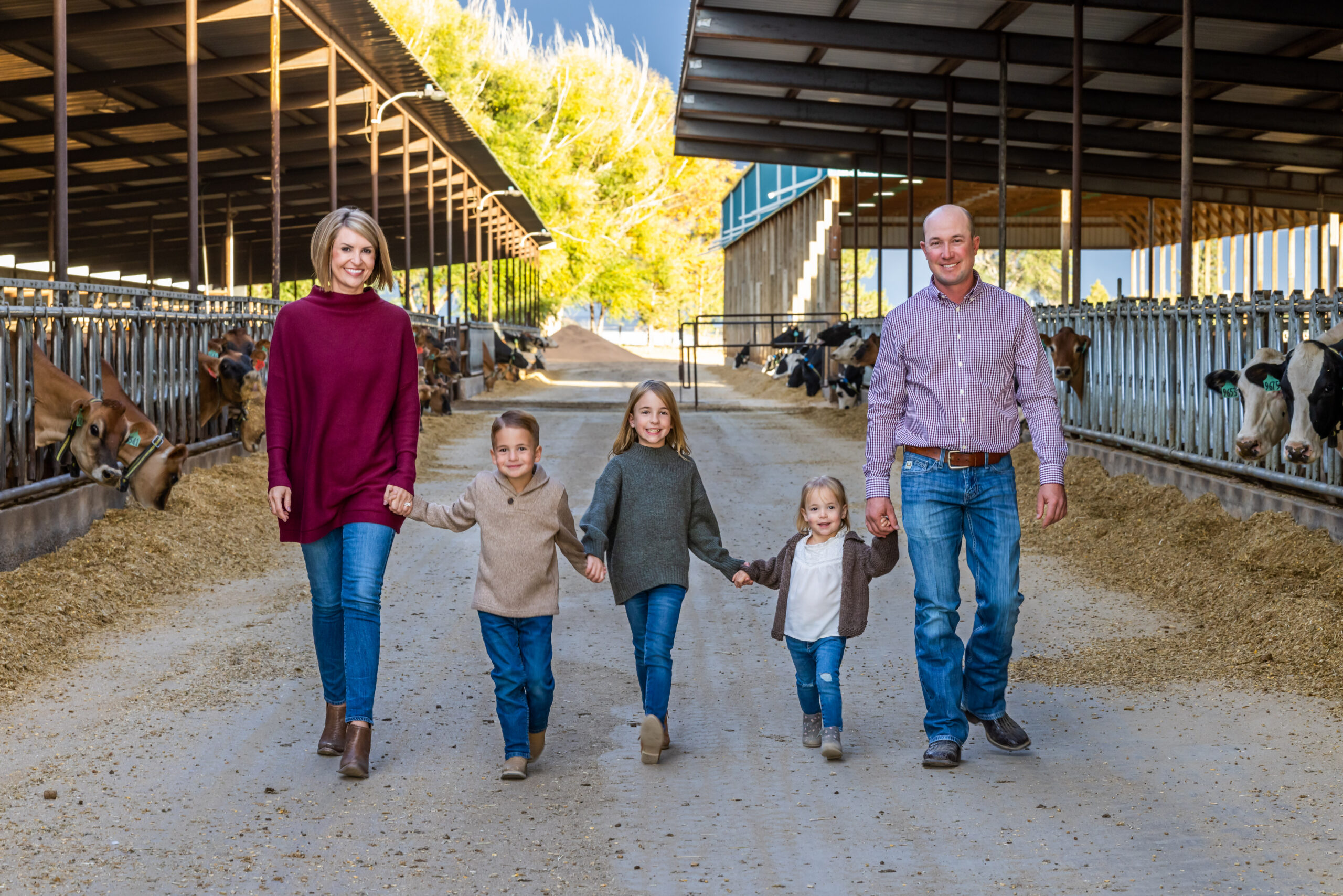
Five Generations Deep, and Still Finding New Ground
For Josh Docheff of Blue Sky Dairy in Mead, Colorado, dairy farming isn’t a career choice — it’s a family thread stretching back more than a century, to great-great-grandparents who immigrated from Bulgaria and started milking cows in the North Denver area. His grandfather still dairies with family nearby, and his parents bought the current property in 1987. Today Josh, milking around 700 cows across Holstein, Jersey, and Brown Swiss, is carrying the operation into its fifth generation, on land that’s changed dramatically: what was once rural farmland now sits two miles from a 15,000-house neighborhood, with 2,000 more apartments on the way, and a new interstate frontage road that recently took 10 acres of the family’s property.
Land isn’t the only thing that’s changed over the generations. In 2008, Josh’s parents processed their own milk, too, first buying into a facility in Denver, then building one on the family’s own property, aiming for more control over their product. But scaling a niche, on-farm brand while still moving milk from 350 cows proved difficult — everyone says they care about quality, Josh has found, but at the grocery store level, price usually wins. The venture wound down in 2011, and Blue Sky Dairy went back to shipping milk through the co-op.
But the itch to try again didn’t go away. Almost a decade later, in 2020, the DeGroot family, starting their own processing business, approached Josh about leasing his family’s idle plant. After about two years, Josh proposed reselling DeGroot milk through their farm store, Rocky Mountain Milkhouse, to rebuild a customer base gradually, avoiding the hard stop-start transition they’d faced before. From there, the store grew organically: milk and cream first, then kefir, cheeses, and farm-raised meats. About a year ago, the DeGroots outgrew the shared plant and moved to their own facility roughly 10 miles away; Rocky Mountain Milkhouse took over the vacated building and started making ice cream there. The two operations now run separate stores, but Rocky Mountain Milkhouse still sources and resells DeGroot milk alongside its own products.
With the plant back up and running, the bigger question was never volume — Josh has never had ambitions of moving all 700 cows’ worth of milk through the store. Instead, he’s leaned into the farm’s proximity to people by inviting them in — calf pens visitors can walk into, goats and lambs to meet, a close-up pen where newborns are sometimes visible from the store. The most common reaction, he says, is surprise at how big dairy cows actually are. Growth hasn’t been perfectly steady — the same frontage road project cut off store access for about three months — but sales are recovering. The milk itself is a differentiator too: non-homogenized and 4 to 4.5% fat, well above Colorado’s 3.25% whole milk standard. It’s resonated with an unexpected customer base — Eastern European families who tell Josh it tastes like the milk they grew up with, an echo of his own family’s arrival from Bulgaria more than a century ago.
That same hands-on approach carries over to how Josh runs the herd. Blue Sky Dairy has worked with AgSource for nearly seven years, using services that include monthly component testing for culling decisions and support for managing the herd’s registered genetics across the Jersey, Brown Swiss, and Holstein associations. This past summer, two AgSource team members visiting Colorado dairies sat down with Josh and walked him through MyAgSource, the online portal for viewing lab results — something he hadn’t used before despite years as a customer. Since then, he’s been working through the portal’s tools, from tracking somatic cell trends against his own goals to comparing month-to-month production, and he calls it exactly the kind of data he enjoys digging into.
For other multi-generation dairies weighing whether to process their own milk or open a farm store, Josh’s advice is simple: be open. Most first-time visitors have never set foot on a working dairy, and they come with a lot of questions. He’s found that patience with those early conversations pays off — people leave more informed and often become regulars. After a family’s first two or three visits, he says, it settles into something simpler: a wave, and a “How are you doing?”
Find more producer stories: A Hail Mary That Paid Off: Terry DeGroot’s Path to a New Kind of Dairy