
MIR Soil TESTING
What is MIR soil analysis?
MIR soil testing uses mid-infrared (MIR) spectroscopy to shine infrared light on a dried, finely ground soil sample and measures what reflects back. Minerals and organic matter each absorb light in their own way, so the result is a spectral fingerprint of that soil.
Unlike standard soil testing, which measures each property with its own lab method, MIR uses one scan to estimate several properties at once. Those estimates come from calibration models built on a large library of soils tested by traditional lab methods, and they’re routinely checked against new lab results.
MIR is a good fit for agronomists, crop consultants, growers and soil health programs that need consistent soil data across many samples, fields or seasons. Every scan is stored, so samples can be revisited as new prediction models are developed.
Want to discuss how MIR could fit in your program?
How it works
Every MIR result ties back to traditional lab analysis, from the first scan to the latest model update.
Prep
The sample is dried and finely ground so every scan is consistent.
Scan
A spectrometer captures the soil’s infrared fingerprint.
Predict
Calibration models built from lab-tested soils estimate soil properties from the scan.
Verify
A portion of samples is routinely run via traditional lab methods to check predictions and keep models advancing.
What does MIR measure?
MIR provides a detailed look at soil carbon, nitrogen and physical makeup from a single scan.
Soil carbon and nitrogen
Physical soil characteristics
…and more!
How to get started

1. Plan your sampling
Decide which samples you’d like to add MIR analysis to. MIR is an excellent add-on test for existing fertility samples or a field composite sample, and a good way to get more data on trouble spots.
2. Collect samples
Collect samples using your normal soil sampling procedures. Note the sampling depth on your submission form and select MIR analysis.
3. Submit samples
Complete as much information as possible on the submission form and ship samples with forms to your local AgSource lab.
Frequently asked questions about MIR analysis
Does MIR replace my current soil test?
No. MIR supplements traditional analysis and depends on it. Every prediction is only as good as the lab data behind it.
AgSource performs routine quality assurance on all laboratory analysis, ensuring the data feeding our MIR models is accurate
and reliable.
How accurate is MIR?
Accuracy depends on the property and on how well the reference library represents your soils. Our team develops models for MIR analysis that are validated against our own database, as well as using regionally specific, extended databases that are publicly available. That’s why MIR offers a more limited set of analytes than traditional chemistry methods. The list of available analytes will grow as additional models are developed and verified.
Where can I learn more about the science?
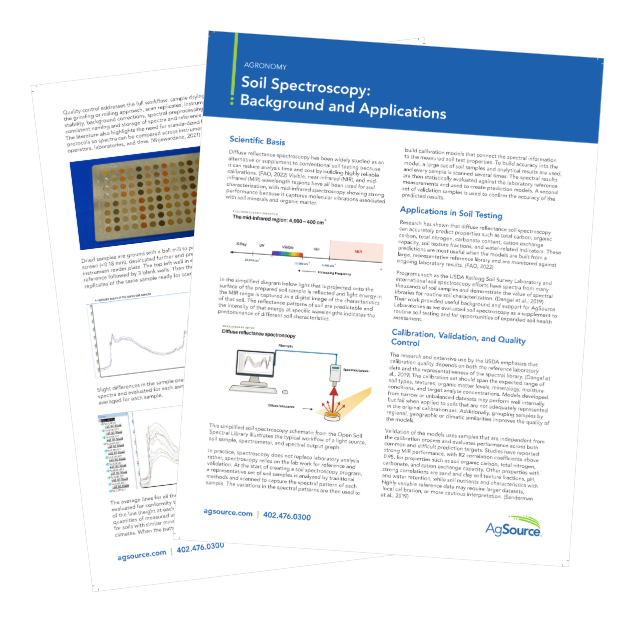
Read our technical overview, Soil Spectroscopy: Background and Applications.
Who do I contact with questions?
Call us at 402.476.0300 or contact us to reach an AgSource soil specialist.